You built your private practice around genuine care for the people you work with. But if your website isn’t bringing in inquiries, the issue usually isn’t your qualifications or your approach. It’s the site itself, and most of the time it comes down to a handful of specific, fixable problems.
I’ve built and redesigned websites for therapists and counselors in private practice, and the same issues come up over and over. Here are the five that consistently cost practices the most new client inquiries.
1. Your Site Speaks to Everyone, So It Connects with No One

The most common thing I see on therapist websites is a services page that lists every condition under the sun: anxiety, depression, stress, life transitions, relationship issues, and trauma. It’s all accurate. But to a potential client reading it, it says nothing.
Someone searching for a therapist for postpartum anxiety is not looking for a generalist. They’re looking for someone who understands what they’re going through right now. A site that speaks directly to that experience will get the inquiry. A site that lists twenty conditions will not.
This is also an SEO problem. Google can’t rank a page that’s trying to be about everything. A page optimized for “postpartum anxiety therapist in Austin” has a clear topic. A page titled “therapy services” does not.
The fix is to get specific about who you help and write your service pages around that. You can still work with a range of clients. Your website just needs to lead with your strongest niche so the right people feel immediately understood.
2. The Experience on Mobile Feels Broken
More than 60% of people searching for a therapist are doing it on their phone. They found your site. Now they need to be able to use it.
If the text is tiny, the menu is hard to tap, pages take more than three seconds to load, or the booking button is buried, they’re gone. And they’re not coming back.
I worked with a therapist whose previous site looked polished on desktop but had a contact form that was completely broken on mobile. She had no idea. She’d only ever looked at her own site from her laptop.
Mobile usability is also a direct Google ranking signal. A site that frustrates mobile visitors gets pushed down in search results over time. The two problems compound each other: it’s harder to find and harder to use when someone does find it.
The things that matter most here are a simple top menu with no more than five items, a booking or contact button visible on every page, text large enough to read without zooming, and pages that load in under three seconds. None of this requires a full redesign, but it does require someone who actually checks the site on a phone.
3. Your Photos Are Sending the Wrong Message

LTherapy is built on trust and human connection. Your photo is often the first moment a potential client decides whether they want to reach out.
Generic stock images of people laughing in fields don’t build that trust. Neither does a blurry photo taken in bad lighting. Neither does no photo at all.
What works is a clear, warm, professional headshot that looks like you on a good day. Not stiff, not overly formal, not the photo from your graduate school ID. Something that makes a person think: I could talk to this person.
A professional headshot session typically costs $150 to $400. The difference it makes on inquiry rates is not subtle. It’s one of the highest-return investments you can make in your practice’s online presence, and it’s the first thing I recommend when a therapist asks why their site isn’t converting.
If professional photos aren’t possible right now, a well-lit photo taken near a window with a clean background is a significant step up from most alternatives.
4. You’re Not Telling Visitors What to Do Next
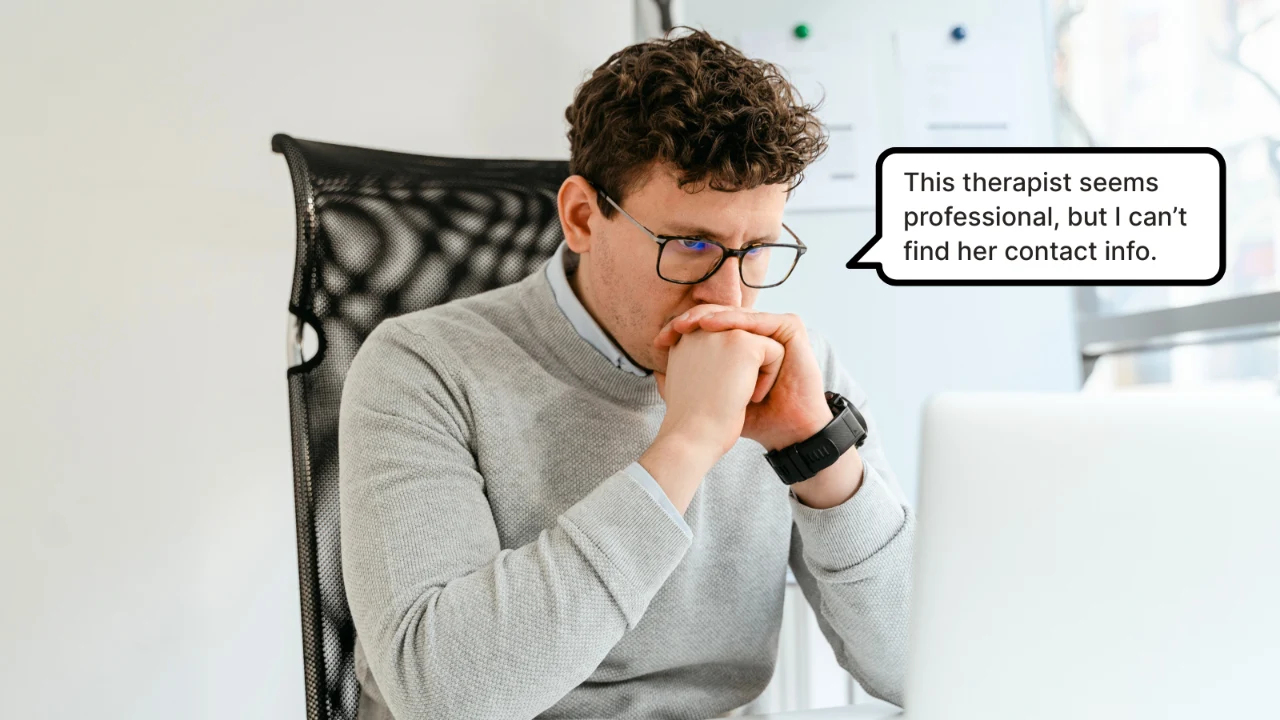
Someone reads your About page. They connect with how you describe your approach. They think this might be the right person. And then the page just ends.
No button. No next step. No instruction. They close the tab and the moment passes.
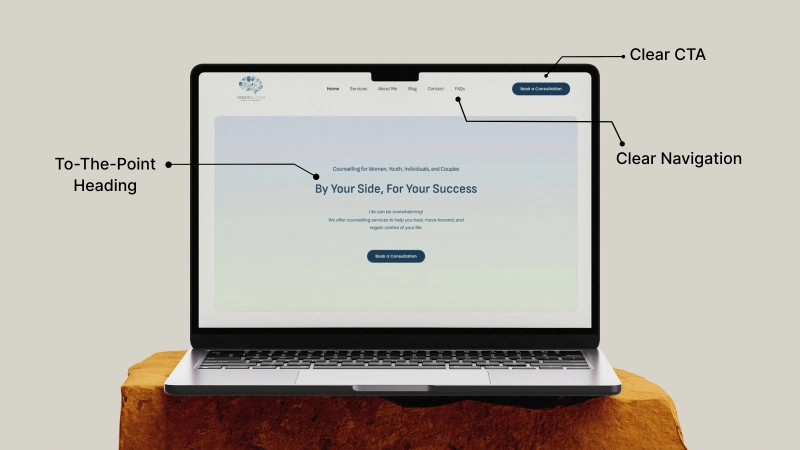
Every page on your site needs a clear call to action. Not subtle, not buried at the bottom, not just a link in your navigation bar. A visible button that tells the visitor exactly what to do and makes it easy to do it.
For most therapy websites this means something like “Schedule a free 15-minute consultation,” “Book your first session,” or simply “Get in touch.” The specific wording matters less than the clarity and placement. It should appear near the top of your homepage, at the end of every service page, and at the bottom of your About page at minimum.
The reason this gets missed so often is that therapists think it feels pushy. It doesn’t. To someone who’s worked up the nerve to look for help, a clear next step is a relief.
5. Google Has No Idea Your Site Exists

You could have a beautifully designed, emotionally resonant therapy website, and if it’s not optimized for search, almost no one will ever see it.
SEO for therapy websites is not complicated, but it does require intention. The basics that actually move the needle are:
Page titles that include your specialty and location. “Anxiety Therapist in Denver | Sarah Keane, LPC” tells Google exactly what the page is about and who it’s for. “Home | Sarah Keane Therapy” tells Google almost nothing.
Service pages for each specialty. One page called “Services” that lists everything is harder for Google to rank than separate pages for each thing you treat. A page about “teen anxiety therapy” can rank for that specific search. A general services page usually can’t rank for anything specific.
Your location throughout the site. If you’re a therapist in Chicago, that word needs to appear in your page titles, your headings, and your content. Local searches are how most private practice clients find therapists, and Google needs location signals to connect you to those searches.
Fast load times. Google measures how quickly your site loads and factors it into rankings. Large uncompressed images are the most common culprit. This is a technical fix, but it’s a meaningful one.
Getting these fundamentals in place doesn’t require ongoing monthly SEO work. It mostly needs to be built correctly from the start, which is one of the strongest arguments for having a professional handle the initial build rather than a DIY template.
The Common Thread
None of these five problems are about having an ugly website. Most of the therapy sites I see that aren’t performing actually look fine. The issues are in the structure, the specificity, the mobile experience, and the SEO fundamentals. Those are the things that determine whether a site brings in clients or just sits there.
Small focused changes in these areas tend to have a bigger effect on inquiries than a full visual redesign.
Frequently Asked Questions
Why isn’t my therapy website showing up on Google?
The most common reasons are that your page titles don’t include your specialty or location, your site doesn’t have dedicated pages for each service you offer, or your site loads too slowly on mobile. Check all three before assuming the issue is bigger than it is.
My website looks nice. Why isn’t it bringing in clients?
Design and conversion are two different things. A site can look polished and still fail to convert if it doesn’t have clear calls to action, if it speaks too broadly to connect with anyone specific, or if the contact process has friction. A professional appearance builds initial trust, but the structure of the site determines whether someone takes the next step.
Do I need a separate page for each therapy specialty?
Yes, if you want to rank for each one. A single services page that lists everything is hard for Google to rank for any specific search. Individual pages for each specialty, written with that specialty and your location in the title and heading, give Google something concrete to work with.
How important are photos for a therapy website?
Very important. Your photo is often the moment a potential client decides whether to reach out. A warm, clear, professional headshot builds more trust than any written description of your approach. It’s one of the most cost-effective investments you can make in your practice’s online presence.
Is blogging really worth my time?
Yes, when done right. Writing helpful posts about topics your ideal clients care about (like “How to Manage Anxiety Before a Big Life Change”) builds trust and helps Google see you as an authority. You don’t need to post every week—quality matters more than frequency.
Do I need a professional web designer?
You can build a site yourself, but a professional saves you time and ensures your website actually converts. Many DIY sites look fine but miss technical and SEO details that stop clients from finding or contacting you.
If your therapy website isn’t bringing in the inquiries your practice deserves, I’d be glad to take a look.
I offer a free discovery call where we go through your site and identify exactly what’s holding it back. Check my portfolio or reach out directly to get started.