Most therapists spend more time picking a website platform than they do writing the actual content that would bring clients in. And the advice floating around therapist Facebook groups rarely acknowledges the real trade-offs on either side.
Here’s an honest look at Wix vs WordPress for therapists – what each platform does well, where each one fails you, and which one fits where your practice is right now (and where it’s going). By the end, you’ll have a clear answer rather than the usual “it depends” non-answer.
What Wix and WordPress Actually Are (and Why It Matters for Your Practice)
Wix is a fully hosted, all-in-one website builder. You pay a monthly fee, and they handle the hosting, security updates, and technical maintenance. You just log in and build. Think of it as renting a fully furnished apartment – everything works, but you’re subject to the landlord’s rules.

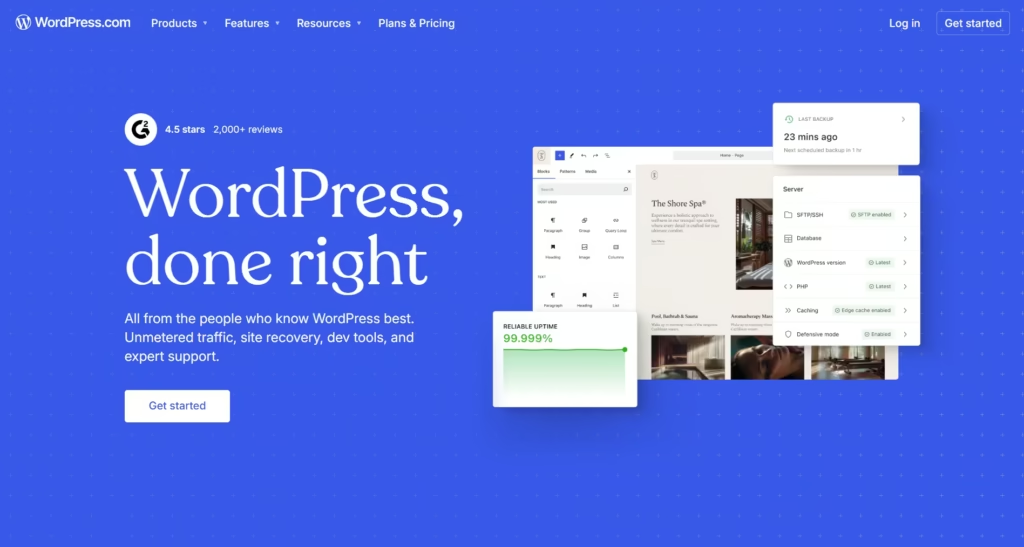
WordPress (specifically WordPress.org, not the stripped-down WordPress.com) is a self-hosted platform. You own the land. You choose your hosting company, install WordPress, manage updates, and add plugins. More responsibility, but full control over everything.
Cost-wise: Wix runs $17–$36/month depending on your plan. WordPress hosting typically costs $5–$15/month, though you’ll add theme and plugin costs on top of that – often landing in the same ballpark once you’re set up.
When Wix Makes Sense for Your Therapy Practice
Wix is a genuinely good fit for therapists who need to get online quickly without learning anything technical.
The drag-and-drop editor is forgiving. You can move things around, change colors, swap photos, and publish without touching code or worrying about breaking anything. Wix’s AI site builder (ADI) can generate a starter website in minutes, which is useful if staring at a blank page feels overwhelming.
For therapists in mid-size cities or towns with limited competition, Wix’s built-in SEO tools are often enough to show up in local searches. You’re not going to outrank a well-optimized WordPress site, but you don’t necessarily need to.
Two real limitations worth knowing before you commit: First, Wix contact forms are not HIPAA-compliant by default. You’ll need a third-party tool – JotForm HIPAA, Hushmail, and SimplePractice for intake are the most common options therapists use. Second, once you choose a Wix template and build on it, switching to a different template means rebuilding your site from scratch. It’s not a dealbreaker, but it’s worth knowing upfront.
If you want to fill a small caseload in a mid-size town and you hate tech, Wix can genuinely work for you.
When WordPress Is Worth the Learning Curve
WordPress powers roughly 43% of all websites on the internet, and that’s not an accident. The platform scales in ways Wix simply doesn’t.
For therapists focused on SEO, WordPress gives you full control. Plugins like Yoast or Rank Math let you optimize every page, set schema markup, and adjust technical settings that Wix locks you out of entirely. That matters more than most people realize when you’re trying to rank for specific searches.
The bigger opportunity with WordPress is niche service pages. A therapist can build individual, fully optimized pages for EMDR therapy, trauma-informed CBT, OCD treatment, grief counseling, and postpartum anxiety – each one targeting a different search term, each one able to rank independently. That kind of content architecture is difficult on Wix and straightforward on WordPress.
WordPress also grows with your practice. Want to add a group practice directory, sell a course, or create a client resource library down the road? You can do it without switching platforms. And because you host it yourself, you own everything – if your hosting company closes, you take your site with you. Wix doesn’t offer that.
The honest downside: there is a learning curve. Expect 5–10 hours to get comfortable, and plan to stay on top of plugin updates, backups, and occasional security maintenance. Page builders like Elementor or Divi make the design side manageable without code, but WordPress requires more ongoing attention than Wix.
Therapists who want to be found on Google for specific specialties – especially in competitive cities – almost always outgrow Wix.
Wix vs WordPress for Therapists: Side-by-Side
| Feature | Wix | WordPress |
|---|---|---|
| Ease of setup | Very easy | Moderate |
| Monthly cost | $17–$36/month | $10–$25/month (hosting + plugins) |
| SEO control | Basic | Advanced |
| HIPAA-compliant forms | Third-party required | Third-party required |
| Template flexibility | Limited after launch | Unlimited |
| Content ownership | Platform-dependent | You own it fully |
| Best for | New practices, simple sites | Growth-focused, niche SEO |
| Blogging for SEO | Decent | Excellent |
| Plugin/integrations | Limited | Thousands available |
The Question Behind the Question
Here’s what the platform debate often misses: the platform is not what fills your caseload.
Your content, your niche clarity, and your local SEO strategy are what bring clients in. A beautifully built WordPress site with no real content strategy fails. A simple Wix site with consistent blog posts targeting “anxiety therapist in New York” can work. The platform is just the foundation – what you build on it is what matters.
That said, if you’re serious about growing beyond word-of-mouth referrals, WordPress gives you tools Wix doesn’t. Full schema markup. Faster page load optimization. The ability to build 10–15 specialty service pages that each rank for different searches. Those things compound over time in ways a basic Wix setup can’t replicate.
Therapists in competitive markets – New York, LA, Chicago, Austin – who try to rank on Wix consistently report difficulty gaining real ground. That’s not just anecdotal. It’s structural. The platform limits what’s technically possible, and in saturated markets, technical SEO precision is often what separates page one from page four.
Common Questions Therapists Ask About Wix vs WordPress
Is Wix good enough for a therapy practice website?
Yes, for therapists who are just starting out or running a small, local practice without much competition. Wix handles the basics well – pages, contact forms with third-party HIPAA tools, and local SEO. Where it falls short is advanced SEO control and scalability as your practice grows.
Is WordPress better than Wix for therapist SEO?
Generally yes, especially for practices that want to rank for specific therapy niches or serve clients in competitive cities. WordPress gives you full control over technical SEO, schema markup, and page structure in ways Wix does not allow, which adds up to a meaningful advantage over time.
Do I need to know coding to use WordPress as a therapist?
No. With page builders like Elementor or Breakdance, you can build a professional therapy website on WordPress without writing a single line of code. There is still a learning curve compared to Wix, but most therapists get comfortable with it within a few days of hands-on time.
Which platform is HIPAA-compliant for therapists?
Neither Wix nor WordPress is HIPAA-compliant out of the box. Both require a third-party HIPAA-compliant form solution – JotForm HIPAA, Hushmail, and SimplePractice for client intake are the most common options. This is true regardless of which platform you choose.
So, Which One Should You Choose?
New practice, lower-competition area, wants to launch this week: start with Wix. It’s faster to set up, easier to maintain, and more than capable of getting you online with a professional-looking site.
Six to twelve months in, with a defined niche and clients in a competitive city: WordPress is the move. The investment in learning it pays off in SEO flexibility and long-term growth that Wix’s architecture won’t support.
Neither platform grows your practice on its own. Your content, your niche pages, and your local SEO strategy do the work. The platform just needs to get out of the way.
Most therapists I talk to chose their platform because someone in a Facebook group recommended it, not because they actually compared SEO capabilities or thought through where their practice would be in two years. If you’d rather skip the trial-and-error entirely, I build websites for therapists in private practice – on WordPress, set up with local SEO, HIPAA-compliant forms, and niche service pages from day one, using design language that fits the way therapists actually talk about their work. See how I build therapist websites or reach out if you want to talk through what makes sense for your practice specifically.